5901 Botham Jean Blvd, Dallas, TX 75215
Why Recycling Prototype Solar Panels Is Key to a Sustainable Future
January 6, 2026By 2050, global solar panel waste could exceed 200 million tonnes. This staggering projection reveals a critical challenge for the renewable energy sector. Without proper end-of-life management, the technology designed for a sustainable future could become an environmental burden. In Texas, where solar capacity is expanding faster than in almost any other state, the need for industrial-scale solutions is immediate.
Traditional solar panel manufacturing follows a linear model. Raw materials like silicon, silver and glass are converted into panels, which are discarded at the end of their life. This approach wastes valuable raw materials and creates a growing waste stream that strains our environmental systems. For 2025, the focus has shifted toward reclaiming these materials to feed the next generation of energy infrastructure.
What Are the Main Challenges in Recycling Solar Panels?
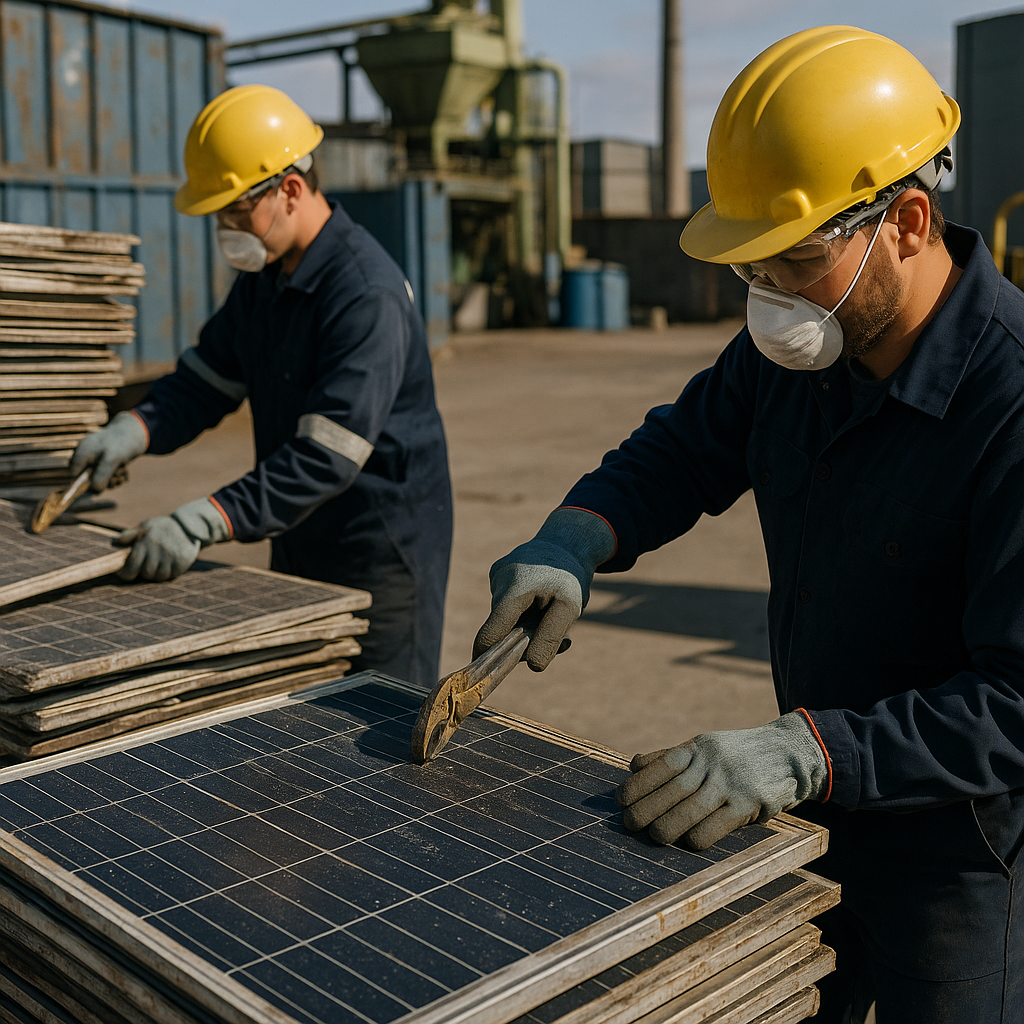
Recycling solar panels presents significant challenges due to their design and current market conditions. These challenges span technical, economic and infrastructure domains, creating a complex web of barriers that must be addressed for effective material recovery.
Design Complexity and Material Separation
The durable construction that makes solar panels weather-resistant for decades simultaneously creates major recycling difficulties. Crystalline-silicon panels utilize strong ethylene vinyl acetate (EVA) encapsulants that bond multiple layers together, including tempered glass, aluminum frames, silicon cells and polymer backsheets.
Removing EVA is one of the most challenging aspects of recycling. It requires either high-temperature thermal treatment or chemical dissolution using specialized solvents. If not managed by professionals, these processes can damage valuable components like silver electrodes and silicon wafers, reducing their resale value as secondary commodities.
Economic Barriers and Market Viability
Current recycling economics present a fundamental challenge to widespread adoption. Processing costs frequently exceed the value of recovered materials, making recycling financially unviable without strategic industrial partnerships or regulatory mandates. The revenue potential varies significantly by component; while aluminum frames add immediate value, the complex separation of silver and silicon requires high-volume processing to remain profitable.
According to research from the Proceedings of the National Academy of Sciences, historically only about 10 percent of photovoltaic panels have been recycled. However, in 2025, rising commodity prices for silver and copper are beginning to flip the script, making “urban mining” of solar farms a more attractive financial proposition for Texas developers.
New in 2025: Texas Senate Bill 3229 and Decommissioning Mandates
As of late 2025, the legal landscape in Texas has shifted significantly to address the solar waste challenge. New state mandates now require solar facility owners to plan for the “end” before they even begin construction. For industrial operators, this means recycling is no longer just a choice—it is a matter of compliance.
Mandatory Financial Assurance
Under Texas Senate Bill 3229, solar developers must now provide financial assurance—such as a bond or letter of credit—to ensure that the cost of decommissioning and recycling is covered. This protects landowners from being left with thousands of tons of orphaned solar panels. This legislation has spurred a massive demand for certified recycling partners who can provide the necessary documentation to satisfy state regulators and insurance providers.
The “Recycle-First” Requirement
In addition to financial bonds, new 2025 guidelines from the Texas Commission on Environmental Quality (TCEQ) encourage a “recycle-first” hierarchy. This means that if a panel can be practicably recycled, it should not be sent to a landfill. Industrial recyclers like Okon Recycling provide the essential bridge here, offering the high-volume processing capacity needed to handle utility-scale decommissioning projects across West Texas and the Panhandle.
What Innovative Recycling Processes Are Being Developed?

Recycling technologies have advanced to include processes that go beyond basic mechanical separation, utilizing precision engineering and innovative chemistry to maximize material recovery from specific panel technologies.
Crystalline Silicon Panel Processing
Automated disassembly systems now remove aluminum frames and junction boxes without damaging the glass substrate. Pyrolysis is a breakthrough in polymer removal, heating panels to 500 degrees Celsius in controlled atmospheres to burn off EVA and backsheet polymers while preserving silicon wafers and metal interconnectors.
Advanced Processing and Hydrometallurgy
Hydrometallurgical processes use selective dissolution to extract materials from thin-film panels. Acid leaching dissolves specific metals while leaving others intact, enabling the recovery of high-purity semiconductor materials for remanufacturing. Chemical precipitation then separates individual metals from solutions, purifying each material to manufacturing-grade specifications. The process achieves recovery rates exceeding 90 percent for critical materials.
| Component | Recovery Rate | Secondary Market Industry |
|---|---|---|
| Aluminum Frames | 100% | Construction & Automotive |
| Glass Cullet | 95% | Fiberglass & Insulation |
| Silver & Copper | 98% | Electronics Manufacturing |
| Silicon Wafers | 85% | Solar & Semiconductor |
The Chemistry of Recovery: Reclaiming Silver and Silicon
To truly achieve a circular economy, recyclers must reach beyond the “low-hanging fruit” of aluminum frames and glass. The true industrial value lies in the microscopic layers of the solar cell itself.
Silver Etching and Electrolysis
Silver is the most valuable material in a standard solar panel per pound. In late 2025, advanced facilities are using a refined etching process that uses nitric acid or methanesulfonic acid to strip the silver “fingers” from the silicon cell. Once the silver is in a liquid solution, it is recovered through electrolysis, resulting in 99.9 percent pure silver that can be sold back to the industrial electronics market at a premium.
Silicon Purity Standards
Recovering silicon is energy-intensive but significantly more sustainable than refining it from quartz sand. Modern “Urban Mining” facilities can now recover silicon at a purity of 5N (99.999%). This high-purity silicon is a critical feedstock for the semiconductor industry. By recycling silicon, we reduce the energy demand of new wafer production by over 70 percent, proving that the circular economy is as much about energy security as it is about waste management.
How Is Automation Transforming the Solar Recycling Process?

Advanced robotics systems dismantle solar panels with precision unmatched by manual processes. Robotic arms equipped with specialized grippers navigate complex panel structures to separate aluminum frames, glass sheets and photovoltaic cells without damaging the materials. These systems operate continuously, processing volumes that would require dozens of workers to handle manually.
Machine vision technology guides each disassembly step through real-time analysis. Computer vision systems identify optimal separation points, detect material composition differences and adjust robotic movements accordingly. This prevents costly mistakes and ensures that every material stream remains pure and uncontaminated. Throughput capacity increases significantly when automation replaces manual labor bottlenecks, making recycling economically competitive with disposal.
What Is the Economic and Strategic Potential of Solar Recycling?
Market Growth and Material Value Recovery
The solar recycling market is one of the fastest-growing sectors in industrial waste management. Currently valued at approximately $460 million, projections indicate expansion to $80 billion by 2050. Silver content alone provides $15 to $23 per panel at current market prices. Material recovery often costs less than mining new resources, and recycled materials offer a buffer against mining shortages or trade restrictions.
ESG Advantages and Investor Capital
Corporate adoption of solar recycling offers measurable ESG (Environmental, Social and Governance) benefits highly valued by investors. Recycling programs directly support Scope 3 emission reduction goals by eliminating the carbon footprint associated with mining. These programs provide auditable metrics that enhance sustainability reporting, offering concrete data for evaluating environmental performance. When businesses collaborate with certified recycling providers, they can claim reduced environmental impact, which enhances brand reputation.
Green Job Creation in Texas
The solar recycling industry supports thousands of jobs across multiple skill levels. Collection and transportation require logistics coordination, while processing facilities need technicians skilled in material separation and quality control. These roles, involving chemical processing and laser ablation systems, require specialized training and technical expertise, offering above-average wages within the Texas manufacturing sector.
Conclusion: Building a Circular Future for Solar Energy
The solar industry is experiencing a transformative moment where recycling innovation is fostering a true circular economy. Advanced technologies now recover over 95 percent of valuable materials from end-of-life panels, transforming what was once considered waste into high-value resources. Silicon, silver and aluminum are being reintegrated into new panel production, creating resilient supply chains that bolster sustainable manufacturing.
This circular approach signifies a fundamental shift where waste management becomes resource management, ensuring solar energy fulfills its environmental promise throughout its entire lifecycle. As municipalities and businesses plan their renewable energy strategies, partnering with experienced recycling providers ensures that materials remain in productive use rather than becoming environmental liabilities.
For comprehensive solar recycling solutions that support your sustainability goals, contact Okon Recycling at 214-717-4083.
Send Us a Message
Questions about what we do? Interested in commercial services? Let us know below and a member of our team will get back to you.