5901 Botham Jean Blvd, Dallas, TX 75215
Why Is Industrial Copper Recycling in Dallas, TX Important?
February 10, 2026Industrial businesses in Dallas discard millions of dollars’ worth of copper each year. This valuable nonferrous metal often ends up in dumpsters, but it holds immense potential for generating revenue and supporting environmental goals. In 2026, as global demand for high-purity copper surges to support the energy transition, the strategic recovery of this metal has become a financial imperative for North Texas manufacturers. Copper recycling uses up to 85% less energy than producing new copper from ore, making it one of the most energy-efficient and carbon-conscious recycling processes in existence today.
Dallas industrial facilities produce significant copper scrap from manufacturing, construction, and equipment maintenance. Copper wiring, pipes, and HVAC system components represent considerable value, yet many businesses overlook them as simple debris. The Dallas-Fort Worth area boasts a well-established recycling infrastructure specifically designed to handle the high-volume requirements of large-scale industrial and commercial operations, allowing facilities to convert their scrap piles into liquid capital.
What Services Do Dallas Recyclers Offer for Industrial Clients?
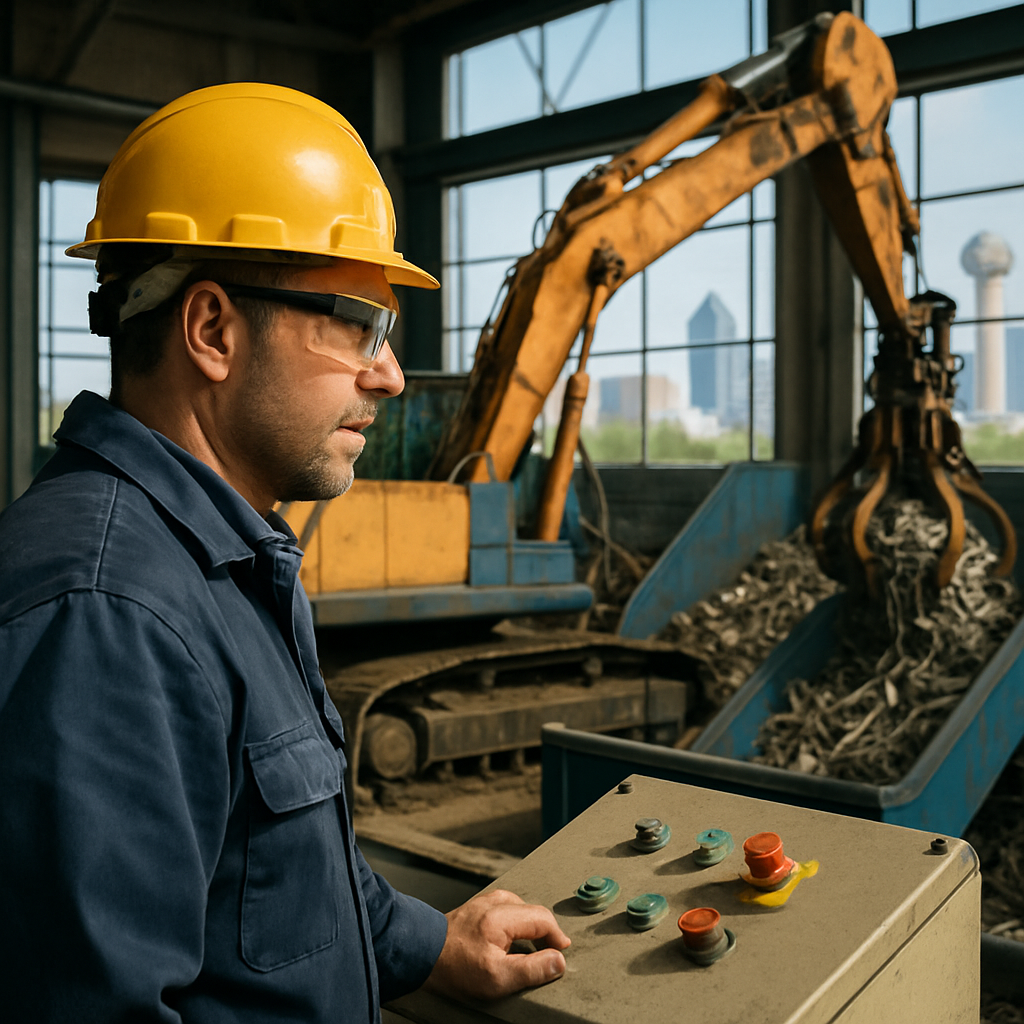
Dallas recycling centers offer extensive services tailored for industrial and commercial operations. These facilities are attuned to the needs of large-scale manufacturing, construction, and industrial clients, providing specialized solutions beyond basic scrap pickup. Services range from container provision to advanced logistics management, all designed to streamline waste management for busy industrial facilities and reduce the administrative burden on site managers.
Container services are integral to industrial recycling programs. Professional facilities provide various containers to accommodate different scrap materials and operational needs. This diversity ensures that metal fabricators, manufacturers, and other industrial clients can find solutions suited to their production processes and space constraints, ensuring a clean and OSHA-compliant work environment.
Container options and specifications
Industrial recycling solutions in Dallas typically offer several container types, each designed for specific materials and operational requirements:
- Roll-off containers: Available in multiple sizes (typically 20, 30, and 40 yards), these open-top containers handle heavy scrap loads, making them ideal for construction sites and manufacturing facilities with large-volume waste streams.
- Gaylord boxes: These large corrugated containers are suitable for lighter metals and provide easy handling for facilities with limited loading equipment or those accumulating scrap inside the building.
- End-dump trailers: These specialized containers allow for quick unloading of bulk materials and are particularly useful for facilities generating consistent volumes of similar scrap types.
- Custom fabricated receptacles: Many recyclers create specialized containers designed to fit specific production floor layouts, such as under-press bins or forklift-ready hoppers.
Scrap box delivery and transport services
Transport services are crucial in industrial recycling programs. High-capacity recycling centers typically offer comprehensive logistics solutions, including the scheduled delivery of empty containers, regular pickup of filled containers, and flexible scheduling to accommodate production demands. These services generally cover the broader Dallas-Fort Worth metroplex and surrounding North Texas counties.
Pickup scheduling varies based on client needs, with many facilities offering 24-hour response times for urgent requests. This responsiveness is valuable for manufacturers and metal fabricators who cannot afford scrap accumulation on production floors. Transport services also include specialized vehicles like flatbed trucks for oversized machinery and van trailers for materials that require protection from the elements.
Technology integration and management systems
Modern industrial recycling has adopted technology to enhance service delivery. GPS tracking systems allow recyclers and clients to monitor container locations and optimize routes. This technology benefits industrial operations by enabling accurate scheduling and detailed reporting for compliance. Advanced reporting systems provide industrial clients with detailed data on recycling activities, including weight measurements, material classifications, and carbon offset metrics—essential for manufacturers aiming to meet ESG (Environmental, Social, and Governance) targets.
The 2026 Industrial Copper Super-Cycle: AI and the Grid
In 2026, the demand for copper has entered a “super-cycle,” driven by two massive industrial shifts: the expansion of Artificial Intelligence (AI) data centers and the modernization of the electrical grid. This global hunger for copper has fundamentally changed the value proposition for Dallas-based industrial generators.
Data center infrastructure demand
Hyperscale data centers being built across North Texas require massive amounts of copper for power distribution, bus bars, and cooling systems. An AI-ready data center consumes several times more copper than a traditional facility. This has created a structural supply deficit, meaning that recycled copper is no longer just “scrap”—it is a critical feedstock for the next generation of computing. Businesses generating copper waste from data center construction or IT hardware upgrades are positioned to receive premium payouts as secondary supply becomes increasingly vital to complete these projects on time.
The electrification of everything
The transition to electric vehicle (EV) fleets and renewable energy storage has further tightened the copper market. EV charging infrastructure and high-voltage transmission lines are copper-intensive. In 2026, many domestic smelters have shifted their focus toward processing high-grade industrial scrap to avoid the energy costs and geopolitical risks associated with mining virgin ore. By recycling locally in Dallas, industrial facilities are supporting domestic manufacturing resilience and ensuring that valuable raw materials stay within the U.S. economy.
Advanced Metallurgical Verification: Precision Grading
In the modern industrial recycling landscape, the days of relying on visual inspection alone are over. Professional facilities utilize laboratory-grade technology at the scale to ensure that industrial accounts are paid for the exact metallurgical content of their scrap.
XRF and LIBS technology in the yard
To provide guaranteed pricing for complex alloys, modern recyclers utilize handheld X-ray fluorescence (XRF) and Laser-Induced Breakdown Spectroscopy (LIBS). These devices provide an instant chemical breakdown of a metal sample. For a Dallas manufacturing facility, this means distinguishing between standard copper and specialized alloys like copper-nickel or beryllium-copper. This precision ensures that high-value materials are not “downgraded” to lower-priced scrap categories, directly increasing the manufacturer’s net revenue and providing a verifiable audit trail for corporate finance teams.
AI-driven optical sorting at scale
For high-volume industrial accounts, Artificial Intelligence (AI) and robotic sorting systems have automated the separation of commingled nonferrous metals. Optical sensors can distinguish between copper, brass, and aluminum at high speeds, removing human error from the sorting process. This technology allows recycling facilities to produce “furnace-ready” packages for domestic mills, which commands a higher price that is passed on to the industrial generator. In 2026, the speed and accuracy of these systems are essential for maintaining the rapid turnaround times required by the North Texas industrial sector.
What Types of Copper and Other Metals Are Typically Accepted?
Recycling facilities in Dallas accept all forms of copper. Accepted items include copper tubing, insulated copper wire, kitchenware, and industrial plumbing parts. Understanding the grades of copper is essential for maximizing the financial return on a scrap load.
Copper materials are categorized by quality grades that determine pricing. No. 1 Copper represents the highest grade with minimal contamination, while No. 2 Copper contains some oxidation or minor impurities. Bare Bright Copper is the “gold standard,” consisting of clean, stripped wire that is bright and shiny. LT Copper (Light Copper) includes lower-grade materials with more contamination but still retains significant recycling value.
Industrial nonferrous and ferrous categories
Besides copper, processing centers handle various other nonferrous metals that resist corrosion. Aluminum materials include siding, wheels, radiators, and high-purity extrusions. Brass recycling encompasses red brass and yellow brass, which command different prices based on their copper-to-zinc ratios. Even ferrous metals, such as structural steel and cast iron, form the foundation of high-volume recycling operations. Tool steel and high-carbon steel from manufacturing applications command specific pricing based on their alloy content and physical condition.
| Copper Grade | Composition | 2026 Market Demand |
|---|---|---|
| No. 1 Copper | Minimum 98% pure, clean, unalloyed | Extremely High |
| No. 2 Copper | 94-96% pure, may contain oxidation | High |
| Bare Bright Copper | 99% purity, bright and shiny wire | Premium Peak |
| Copper Bus Bar | High-purity solid bars from data centers | Critical Supply |
| LT Copper | Sheet copper with some contamination | Moderate |
Why Choose a Certified and Secure Recycling Facility?
SWPPP-certified facilities demonstrate rigorous environmental compliance that exceeds basic recycling operations. These certifications require comprehensive stormwater pollution prevention plans to protect local North Texas waterways from industrial runoff. Industrial clients benefit from partnering with such facilities, as it reduces their own environmental and legal liability under “cradle-to-grave” waste responsibility laws.
Licensed recycling centers operate under strict regulatory oversight from federal and state environmental agencies. Full licensing ensures the facility meets all requirements for safely handling industrial materials, while comprehensive insurance coverage protects both the facility and its clients from potential operational mishaps. Furthermore, secure concrete grounds and containment systems prevent spills from reaching the soil or groundwater, ensuring a truly sustainable recycling process.
Certified scales are perhaps the most important factor for industrial accounts. They ensure accurate, transparent weight measurements for all incoming materials. This transparency builds trust with industrial clients who need precise documentation for their waste streams to satisfy corporate audits and regulatory reporting requirements. Professional facilities maintain current permits and undergo regular inspections, implementing EPA-approved management practices to protect local resources.
Partner with a Dallas Expert for Your Industrial Recycling Needs
Industrial copper recycling in Dallas offers businesses a strategic approach to waste management, providing both environmental and financial benefits. Professional recycling centers throughout the region offer comprehensive scrap metal solutions, including container delivery, scheduled pickup services, accurate weighing, and market-indexed pricing. These facilities handle materials ranging from copper wiring and tubing to transformers and large heat exchangers, ensuring your industrial accounts receive maximum value for every pound.
Choosing the right recycling partner can transform scrap management from a cost center into a significant revenue stream while supporting environmentally friendly practices and corporate sustainability goals. Local centers leverage decades of experience and modern processing capabilities to serve industrial clients with the efficiency they demand.
To turn your scrap copper into a valuable asset and establish a reliable partnership for your ongoing recycling needs, contact Okon Recycling at 214-717-4083.
Send Us a Message
Questions about what we do? Interested in commercial services? Let us know below and a member of our team will get back to you.