5901 Botham Jean Blvd, Dallas, TX 75215
Demolition Debris Recycling in Irving, TX: Disposal Guide
January 29, 2026Demolition projects generate significant amounts of waste materials that require proper handling and disposal. Whether you are a contractor managing a large-scale construction site or a business owner renovating office space, effective debris management directly impacts both project costs and environmental outcomes. The challenge lies in finding solutions that balance logistical efficiency with responsible waste management practices. In 2026, as Irving continues its rapid commercial expansion, the role of material recovery has transitioned from a backend task to a primary operational strategy.
For residents and businesses managing demolition debris recycling in Irving, Texas, there are two primary routes: utilizing professional industrial recycling partners or the city’s municipal services. Private industrial recyclers offer comprehensive solutions, including the demolition support, hauling, and high-yield recovery of materials. These services typically handle everything from the initial teardown to the final certified disposal while prioritizing the circular economy by reclaiming high-value metals and masonry.
How Does the City of Irving Manage Construction and Demolition Debris?
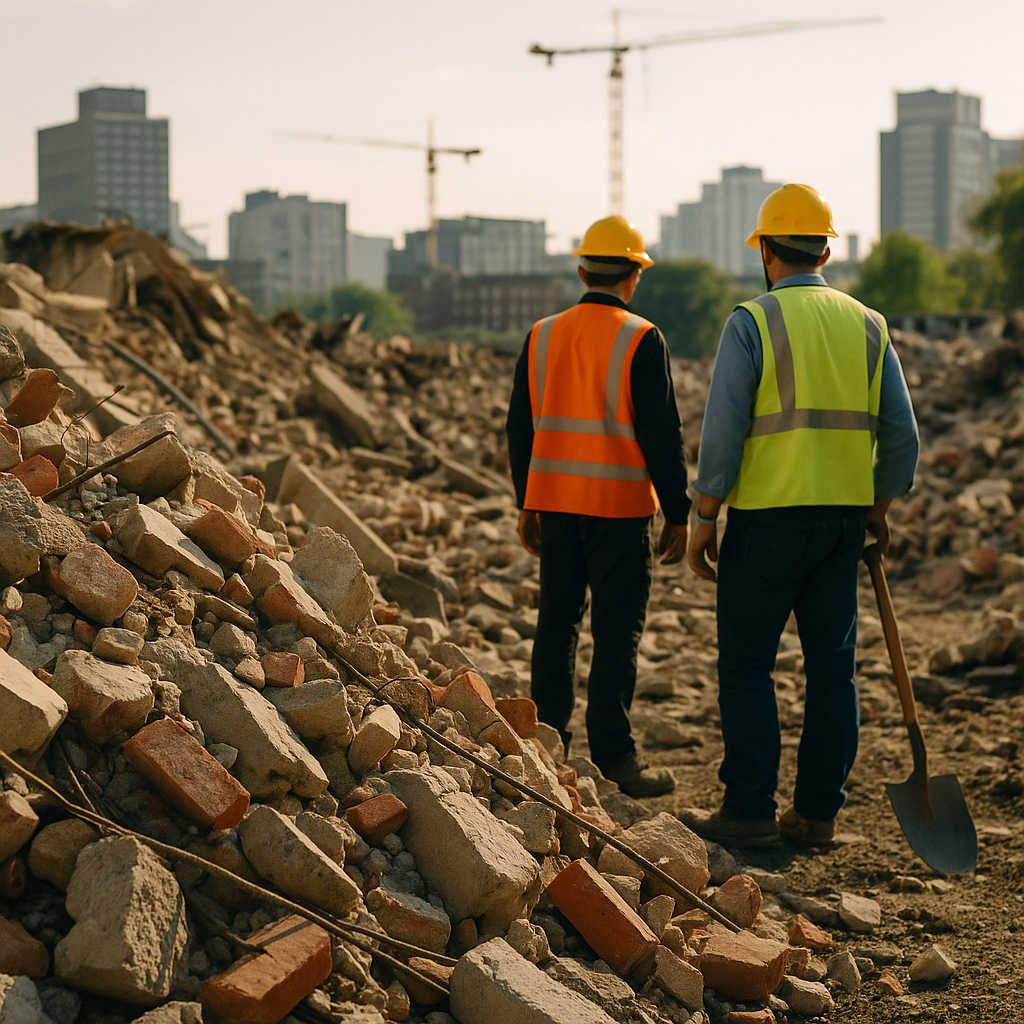
The City of Irving operates a distinct system for construction and demolition (C&D) debris that differs significantly from regular residential waste collection. Unlike household trash, construction materials—such as concrete, rebar, and lumber—cannot be placed at the curb for pickup through the city’s standard solid waste routes.
The Hunter Ferrell Landfill disposal system
All city-managed construction and demolition debris must be transported directly to the Hunter Ferrell Landfill. This facility serves as the designated municipal disposal site for materials such as concrete, lumber, drywall, roofing shingles, cabinetry, and other building components. The landfill accepts these materials from both residents and local contractors who generate debris during renovation or demolition projects. Because this is a municipal site, proof of Irving residency or a local business permit is required for access.
Municipal fee structures and weight limits
The disposal process involves a standard fee structure based on weight. As of 2026, the city charges $48 per ton for C&D debris disposal at the landfill. For smaller residential loads, the fee breaks down into quarter-ton increments. This pricing system ensures a standard rate for local homeowners, though large industrial generators often find that high-volume recycling rebates from professional facilities offer a more attractive financial return.
Roll-off container services for construction
For larger construction projects, the city provides roll-off container rental services to streamline the disposal process. These containers offer a municipal solution for contractors managing significant amounts of debris. The city typically limits municipal roll-off containers to 12-yard and 20-yard sizes. The service includes delivery to the project site and a standard rental period. It is important to note that while municipal bins are suitable for mixed trash, professional recycling bins are required for projects seeking to reclaim the scrap value of structural steel or copper.
Where Can I Drop Off Recyclable Materials in Irving?
The primary municipal location for dropping off basic recyclables is the Recycling Drop-Off Station at the Hunter Ferrell Landfill. This location provides convenient access for residents who need alternative options to curbside collection, especially for bulky items or large volumes of fiber and plastic waste.
The drop-off station operates from 7 a.m. to 5:30 p.m., Monday through Saturday. The facility remains closed on Sundays and city-designated holidays. These consistent operating hours allow residents to drop off materials at their convenience throughout the week, provided they can manage the transportation and unloading themselves.
Accepted municipal materials and process
The drop-off station accepts the same recyclable materials as Irving’s curbside program. These include paper and cardboard, plastics numbered one through seven, metal cans, and glass bottles. Residents can place materials directly into collection containers without requiring special bags. The streamlined process eliminates many barriers for residential recycling, though it is not designed for the high-volume metal turnings or specialized alloys produced by Irving’s industrial sector.
Additional municipal services for masonry
Beyond standard recyclables, residents can often drop off limited quantities of clean dirt, sand, bricks, and gravel. This service requires proof of residency through a valid Texas driver’s license and a matching Irving utility bill. The facility also accepts certain electronics and scrap metal as part of its comprehensive waste collection services, though commercial quantities are usually referred to industrial processing centers.
Maximizing Asset Recovery: The Financial Value of Demolition Scrap
For Irving developers and industrial facility managers, a demolition project is not just a cleanup task; it is an asset recovery opportunity. In the 2026 commodities market, the materials contained within a building’s skeleton possess significant tangible value.
Reclaiming structural steel and rebar
Structural steel is one of the most valuable components of any commercial teardown. When a building is dismantled systematically rather than crushed, the steel beams can be graded as “Prepared Plate and Structural” scrap, which commands a premium price at the mill. Rebar, while lower in value than beams, is almost 100 percent recyclable and represents significant tonnage. By utilizing a professional recycling partner that provides precise on-site weighing and grading, Irving businesses can turn a disposal liability into a project-funding asset.
Harvesting high-value non-ferrous metals
While steel makes up the bulk of the weight, the real “profit” in demolition often lies in non-ferrous metals. Copper wiring, brass plumbing fixtures, and aluminum window frames should be source-separated on the job site. In 2026, the demand for copper is at an all-time high due to its role in the green energy and tech sectors. Ensuring that these materials are not lost to the landfill pile is essential for maximizing the ROI of a renovation project. Industrial recyclers provide specialized bins for these metals, ensuring they stay clean and fetch the highest possible market rate.
Safety and Compliance: Navigating Texas C&D Waste Laws
Demolition is a high-stakes environment where safety and legal compliance are inseparable. Irving contractors must adhere to strict state and federal mandates to avoid environmental fines and workplace accidents.
Managing hazardous materials and “special waste”
Many older structures in the Irving area contain hazardous materials like lead paint or asbestos. Under Texas law, these cannot enter the standard recycling or landfill stream. Furthermore, equipment like commercial HVAC units contains refrigerants that must be recovered by certified technicians. Partnering with a professional recycler who provides “Cradle-to-Grave” documentation ensures that every regulated material is handled according to EPA and TCEQ standards, shielding the property owner from future legal liability.
The importance of LEED and diversion reporting
Modern commercial builds in Irving often target LEED (Leadership in Energy and Environmental Design) certification. To earn these credits, developers must provide detailed diversion reports proving that a high percentage of demolition waste was recycled rather than landfilled. Professional industrial recyclers utilize digital tracking and certified scales to provide auditable reports for every load. This documentation is vital for corporate sustainability reporting and for proving that the project is actively contributing to the North Texas circular economy.
How to Select an Industrial Recycling Partner in Irving

Choosing the right partner for your demolition project requires evaluating more than just price. The best industrial recyclers provide a level of service that streamlines the entire construction lifecycle.
Evaluating logistics and equipment
A high-volume demolition project needs more than just a bin. It requires a logistics partner who can swap out 40-yard containers on demand to prevent site congestion. When selecting a partner, Irving businesses should look for facilities with a large fleet of roll-off trucks and a wide variety of container sizes. Specialized equipment, such as magnetic separators and hydraulic shears, allows for more efficient on-site sorting, which ultimately increases the value of the scrap metal.
Transparency and metallurgical expertise
Not all scrap metal is created equal. A professional recycling partner should utilize advanced technology like XRF (X-ray Fluorescence) analyzers to identify exactly which alloys are present in your waste stream. This ensures you are paid for the actual metallurgical content of your scrap, rather than a flat “mixed iron” rate. Transparency in weighing—using state-certified scales that are regularly calibrated—is the hallmark of a reputable industrial partner. Always choose a recycler who provides detailed receipts with exact weights and current market rates.
Your Guide to Responsible Debris Disposal in Irving
Irving residents and contractors have two primary pathways for responsible demolition debris disposal. Professional industrial haulers provide comprehensive service with labor, specialized transportation, and precision materials sorting to maximize recovery rates. These partners handle the entire process from the job site to the processing facility. Alternatively, the City of Irving’s landfill offers a municipal option for residents who can transport debris themselves, charging by the ton for materials generated within city limits.
Selecting the right disposal method depends on your project scope, budget, and sustainability priorities. For large-scale demolition projects requiring expert material grading and guaranteed recycling compliance, professional services are the industrial standard.
For comprehensive recycling solutions tailored to your project’s needs, contact Okon Recycling at 214-717-4083 to discuss how we can help manage your construction and demolition waste responsibly.
Send Us a Message
Questions about what we do? Interested in commercial services? Let us know below and a member of our team will get back to you.