5901 Botham Jean Blvd, Dallas, TX 75215
How to Safely Dispose of Old MRI Scans and Medical Images
April 1, 2026Healthcare facilities face severe penalties of up to $70,117 per day for improper hazardous waste disposal. HIPAA breach penalties can reach $50,000 per violation for mishandling patient data. These dual challenges make proper MRI disposal crucial for compliance and financial health in medical organizations. In 2026, as environmental oversight reaches new heights in the medical sector, the margin for error has effectively vanished.
MRI scans contain sensitive Protected Health Information (PHI) that must be securely destroyed under federal regulations. The imaging files store patient names, medical histories, and diagnostic details, which can result in significant data breaches if improperly discarded. Healthcare providers need to ensure complete data sanitization before any equipment leaves their facilities.
Beyond data security concerns, MRI machines also present serious environmental hazards through their complex construction materials. These devices contain mercury, beryllium, and powerful rare earth magnets that can contaminate soil and groundwater if not disposed of correctly. Environmental regulations classify many MRI components as hazardous materials, requiring specialized handling and disposal protocols.
What Are the Legal Requirements for MRI Scan Disposal?

HIPAA regulations establish the foundation for all MRI scan disposal requirements in healthcare facilities. The Privacy Rule mandates that covered entities implement appropriate administrative, technical, and physical safeguards to protect Protected Health Information throughout its lifecycle, including final disposal. These safeguards must prevent unauthorized access to patient data while ensuring complete destruction of sensitive medical imaging records.
The destruction standard under HIPAA stipulates that MRI scans must be rendered “unreadable, indecipherable, and otherwise unable to be reconstructed.” This means standard deletion or basic shredding methods do not meet compliance requirements. Professional destruction services must use cross-cut shredding, pulverizing, or incineration for physical films and specialized data wiping or physical destruction for digital storage media.
State law variations in retention periods
Healthcare facilities must comply with both federal and state requirements when determining disposal timelines for MRI scans. While HIPAA does not specify retention periods for clinical records, state laws typically mandate retaining medical records for six to seven years for adult patients. Some states require longer retention periods, particularly for pediatric patients, who may need records maintained until several years after reaching age 21.
State law supersedes HIPAA requirements when it mandates longer retention periods or stricter privacy protections. Healthcare facilities operating across multiple states must apply the most stringent requirements to ensure compliance. This complexity necessitates careful tracking of various state regulations and their specific requirements for medical imaging records.
Certificate of destruction documentation
Professional disposal services must provide a Certificate of Destruction as documented proof of compliance with legal requirements. This certificate serves as critical evidence that Protected Health Information was properly destroyed according to HIPAA standards and state regulations. The documentation must include details about destruction methods, dates, and chain of custody to satisfy audit requirements.
The certificate also serves important business functions beyond compliance documentation. Healthcare facilities can use these records for tax purposes and to demonstrate due diligence in protecting patient confidentiality. Proper documentation helps prevent potential data breaches and provides legal protection against claims of improper disposal.
Business associate agreement requirements
Healthcare facilities must execute Business Associate Agreements with professional disposal services before transferring MRI scans for destruction. These contracts ensure that third-party vendors understand their obligations under HIPAA and implement appropriate safeguards during transport and disposal. The agreement must specify the scope of work and destruction methods to be valid under federal regulations.
Advanced Data Sanitization: NIST 800-88 Compliance in 2026
In 2026, simple formatting of a hard drive is no longer sufficient. Medical imaging devices now utilize sophisticated Solid State Drives (SSDs) and Non-Volatile Memory Express (NVMe) storage, which require specific sanitization protocols outlined by the National Institute of Standards and Technology (NIST).
The three levels of sanitization
Under NIST 800-88 Guidelines for Media Sanitization, healthcare facilities must choose the appropriate level of destruction based on the sensitivity of the data:
- Clear: Simple overwriting of data. This is often insufficient for modern SSDs found in high-end MRI machines due to wear-leveling algorithms that may hide data fragments.
- Purge: A more advanced method involving physical or logical techniques that render data unrecoverable even in a laboratory environment. For magnetic media, this includes degaussing.
- Destroy: The ultimate standard for retiring MRI assets. This involves shredding, disintegrating, or incinerating the drive so that it can never be used again.
Handling embedded patient data
Modern MRI machines are part of the Internet of Medical Things (IoMT). Patient data is not just on the main hard drive; it can be cached in the system’s temporary memory, network interface cards, and backup power units. A professional decommissioning team performs a “deep sweep” of the machine’s architecture to identify and sanitize these hidden data pockets. Failure to address these embedded storage areas constitutes a significant HIPAA violation risk.
Managing the Environmental Impact of Cryogenic Systems
MRI machines rely on liquid helium to cool their superconducting magnets to near-absolute zero. Helium is a non-renewable resource, and its improper release into the atmosphere—known as “quenching”—is both environmentally wasteful and potentially dangerous.
Safe helium recovery vs. venting
During decommissioning, the primary goal is to capture and recycle the helium rather than venting it. Professional disposal teams utilize specialized cryo-compressors to transfer the liquid helium into transport dewars. This recovered helium is then purified and returned to the medical supply chain. Venting, while sometimes necessary in emergencies, is considered a last resort in 2026 due to the high market value of helium and the environmental focus on resource conservation.
Oxygen displacement hazards
If a magnet quenches (rapidly boils off its helium), the expanding gas can displace oxygen in the room, creating an immediate asphyxiation hazard for the decommissioning crew. Professional teams monitor oxygen levels continuously using personal gas detectors and install high-volume exhaust fans before beginning any work on the cryostat. This adherence to OSHA confined space entry protocols is a critical differentiator between professional disposal services and general scrap haulers.
What Are the Approved Methods for Destroying MRI Films and Data?
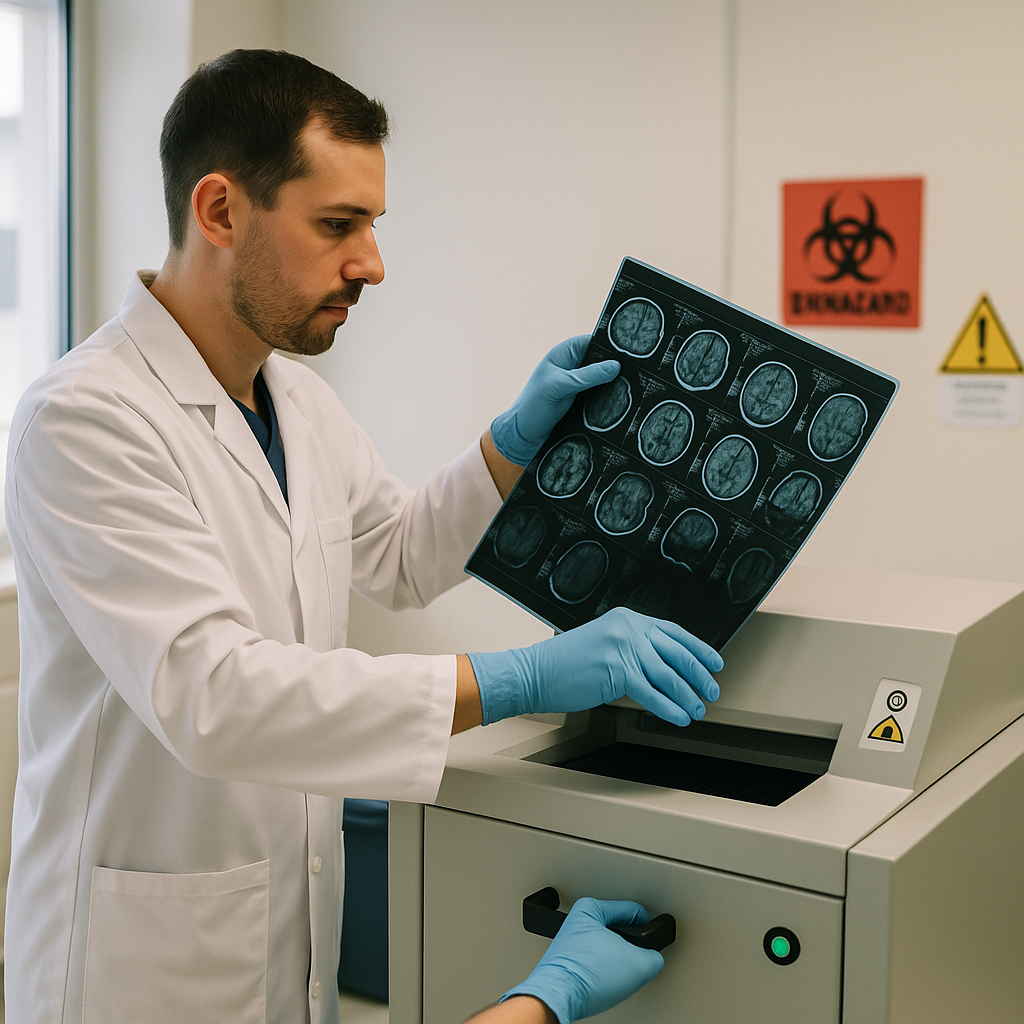
MRI films and associated digital data contain sensitive patient information that requires secure destruction methods. Healthcare facilities must adhere to HIPAA guidelines when disposing of these materials. The choice between physical and digital destruction depends on the type of media being discarded.
Physical MRI films require complete destruction to prevent any possibility of data reconstruction. Digital storage devices from MRI machines present different challenges since they often contain embedded storage systems that standard deletion cannot properly sanitize.
Physical destruction methods for MRI films
Physical MRI films must be destroyed in a way that renders patient information completely unreadable. We recommend several approaches based on facility capabilities and security requirements.
Standard destruction options include:
- Cross-cut shredding using HIPAA-compliant shredders that create particles small enough to prevent reconstruction.
- Burning or incineration at licensed facilities specializing in medical waste disposal.
- Pulverizing films into particles smaller than 1/125 inches to meet regulatory standards.
Digital data sanitization and destruction
Approved digital destruction methods include DOD-level data wiping using software that overwrites data multiple times with random patterns, and degaussing, which exposes magnetic media to strong fields that disrupt stored data. Physical destruction through shredding, crushing, or disintegrating storage devices ensures total security. Cryptographic erasure is used for encrypted drives where encryption keys are securely destroyed.
We use NIST 800-88 guidelines for all electronic media sanitization. These federal standards ensure complete data removal from various storage technologies. Solid-state drives require specialized destruction equipment designed specifically for flash memory components.
Professional destruction services
The most secure approach involves hiring certified destruction services that provide comprehensive documentation. Professional providers offer several advantages over in-house destruction attempts. Licensed services maintain proper equipment for both physical and digital media destruction.
Certified destruction services provide chain of custody documentation from pickup to final destruction, certificates of destruction with detailed asset inventories, and video documentation of destruction processes when requested. They ensure compliance with HIPAA, HITECH, and state privacy regulations.
How Is an Entire MRI Machine Responsibly Disposed Of and Recycled?
Disposing of an MRI machine requires a comprehensive, multi-step approach that prioritizes both safety and environmental responsibility. The process begins with professional decommissioning, where trained technicians safely power down the system and carefully remove hazardous materials, such as cryogens used for cooling. This initial phase is crucial due to the powerful magnetic fields and potentially dangerous substances within MRI machines, which pose significant risks if not properly managed.
After ensuring the system is safely deactivated, specialized technicians begin the systematic disassembly process. They carefully separate the different components using appropriate lifting equipment and custom restraints to prevent damage during handling. The exterior casing and structural elements, typically composed of steel and other common metals, are removed first and directed toward standard recycling channels.
Extracting high-value components
The most valuable phase of MRI recycling involves extracting materials from the superconducting magnet. This core component contains niobium-titanium alloy wires embedded in copper, creating significant recovery value. The niobium-titanium alloys alone can sell for significant sums per pound, making their careful extraction a priority in the recycling process.
Advanced separation technologies play a crucial role in maximizing material recovery. Companies utilize proprietary technologies specifically designed to isolate magnets from end-of-life products and convert them into valuable raw materials. These innovative processes ensure maximum recovery of rare earth elements and other precious materials.
Material separation and processing
The disassembly process continues with sophisticated separation techniques targeting different material types. Eddy current separation proves highly effective for non-ferrous metals like aluminum and copper, which are abundant in MRI machines. This technology allows recyclers to efficiently sort materials based on their electrical conductivity properties.
Copper and aluminum undergo refinement processes where they are melted down and purified for reuse in new applications. The rare earth elements found in the magnets require specialized extraction processes to prepare them for reintegration into new high-tech devices. These materials are particularly valuable because mining new rare earth elements involves environmentally destructive practices and significant energy consumption.
What Are the Options for Used Medical Equipment When Disposal Isn’t Necessary?
Healthcare facilities with MRI machines and other medical equipment that haven’t reached their end-of-service life have several value recovery options. These alternatives to disposal can generate revenue, offset upgrade costs, and extend equipment lifespan through secondary markets.
Direct sale of used medical equipment
Selling used medical equipment directly offers the highest potential return when systems remain in demand. MRI machines, CT scanners, and other imaging equipment often retain significant value if they’re still functional and meet market needs. This option works best for equipment with relatively low usage hours and popular configurations. The direct sale process requires equipment inspections, documentation, and buyer identification.
Consignment services for medical equipment
Consignment provides a middle ground between immediate removal and direct sales management. Facilities can have equipment removed quickly while specialized vendors handle the marketing and sale process. This approach works particularly well when space needs to be cleared for renovations or new installations. The primary trade-off with consignment involves delayed payment until a buyer is secured.
Trade-in programs and parting out
Trade-in arrangements streamline equipment replacement by applying the value of existing systems toward new equipment purchases. This option reduces administrative complexity and often coordinates equipment removal timing with new deliveries, minimizing facility downtime. When complete systems have limited resale value, parting out individual components can still generate revenue. This approach works well for older MRI machines where specific parts retain demand even if the complete unit doesn’t.
A Sustainable Future for Medical Equipment Disposal

Proper disposal of MRI scans and machinery is a crucial responsibility for any healthcare facility. It extends beyond simple regulatory compliance to include patient privacy and environmental stewardship. By partnering with specialized services for secure data destruction and responsible equipment recycling, organizations can avoid substantial fines, prevent pollution, and contribute to a sustainable circular economy. Making responsible MRI recycling a standard practice is a vital step toward a greener, more secure healthcare industry.
Healthcare facilities aiming to establish sustainable MRI disposal practices need experienced partners who understand both regulatory requirements and environmental best practices. Contact Okon Recycling at 214-717-4083 to learn how we can help transform your medical equipment disposal into an environmentally responsible and compliant process that protects patient data while recovering valuable materials for the circular economy.
Send Us a Message
Questions about what we do? Interested in commercial services? Let us know below and a member of our team will get back to you.