5901 Botham Jean Blvd, Dallas, TX 75215
Why Recycling Rare Earth Tube Magnets Is Becoming Essential
December 31, 2025Your smartphone vibrates with incoming calls thanks to tiny rare earth tube magnets. The hard drive in your laptop spins at thousands of revolutions per minute using this same technology. Electric vehicles accelerate smoothly due to powerful permanent magnets containing neodymium and dysprosium.
These critical materials face a severe supply challenge. Traditional mining produces up to 2,000 tons of toxic waste for every ton of rare earth elements extracted. Global refined output is heavily concentrated in single geographic regions, creating hazardous supply chain dependencies. The environmental cost of primary extraction involves massive water consumption and significant carbon emissions that threaten ecosystems worldwide.
Urban mines offer a sustainable alternative. Electronic waste contains concentrated deposits of rare earth elements that can be recovered through advanced recycling technologies. This method reduces environmental impact while enhancing domestic supply security. Recycling rare earth tube magnets from end-of-life products provides a medium-term solution that conserves natural resources and ensures a steady supply of materials for future technology development.
Innovative Methods for Rare Earth Magnet Recovery
As the demand for sustainable critical minerals increases, the industry has shifted from lab-scale experiments to industrial-grade recovery. These innovative methods allow for the extraction of high-purity rare earth elements (REEs) without the heavy ecological footprint of traditional mining.
Mechanical Processing and Powdered Metallurgy
The most direct approach involves mechanically processing discarded magnets through demagnetization and milling. Neodymium-iron-boron and samarium cobalt magnets are heated beyond their Curie temperatures to remove magnetic properties. The brittle, non-magnetic materials are then ground into fine powders smaller than 53 micrometers. This powdered metallurgy technique allows for the creation of new magnets directly from recycled material, a process particularly effective for manufacturing scrap.
Copper Salt Leaching Technology
A cleaner alternative to traditional acid leaching uses copper salts to extract rare earths from shredded electronics. This approach reduces environmental impact compared to harsh sulfuric or hydrochloric acid processes. The copper salt solution selectively dissolves rare earth elements while leaving other metals largely untouched. This method generates fewer hazardous byproducts and is highly effective for processing diverse rare earth magnets found in mixed e-waste streams.
Flash Joule Heating with Chlorination
One of the most significant breakthroughs in the industry is flash joule heating combined with chlorination. This process rapidly heats demagnetized waste to temperatures between 1,230 and 2,000 degrees Celsius in milliseconds. By adding chlorine gas, transition metals like iron and cobalt vaporize, while rare earth oxides remain as concentrated residues.
Recent studies published in the Proceedings of the National Academy of Sciences show that this process reduces energy consumption by 87% and greenhouse gas emissions by 84%. This technology is currently being scaled for commercial deployment in Texas, offering a sustainable alternative that avoids the use of water, solvents, or bulk acids.
| Method | Energy Use | Purity Level | Environmental Impact |
|---|---|---|---|
| Powder Metallurgy | Moderate | High | Minimal (Dry process) |
| Copper Salt Leaching | Low | High | Low (Acid-free) |
| Flash Joule Heating | Very Low | 90%+ | Negligible carbon footprint |
Transforming Recycled Materials into New Magnets
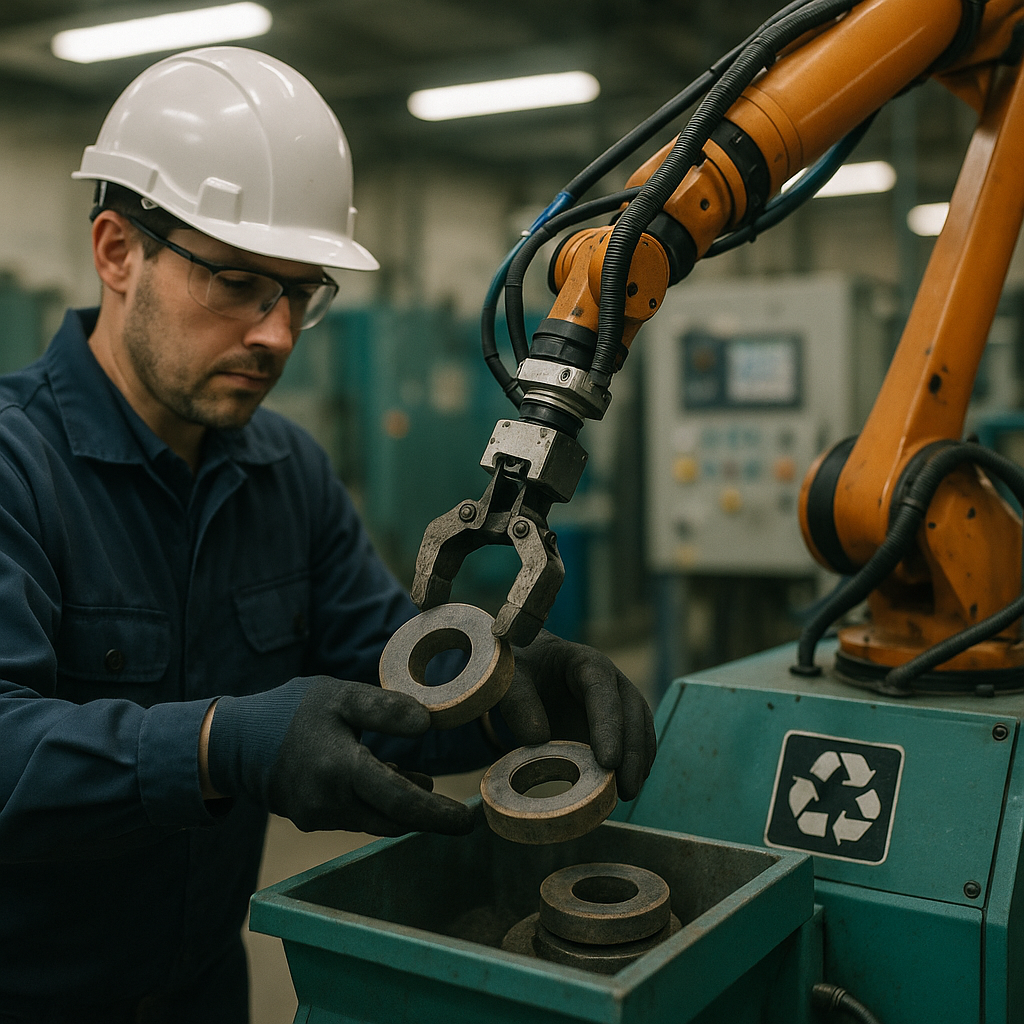
Recycled rare earth elements undergo a sophisticated transformation to become high-performance permanent magnets. The journey relies on advanced metallurgical techniques that ensure the secondary material performs as well as, or better than, virgin ore.
The process begins with rare earth powder obtained from recycling operations. This material typically contains higher concentrations of neodymium and dysprosium compared to natural ore deposits. The journey involves several critical stages to restore magnetic performance.
Powder Preparation and Compaction
Recycled materials are processed into extremely fine powder through controlled milling. This stage ensures uniform particle size distribution, which is vital for the magnetic properties of the final product. Following preparation, the material is pressed into specific shapes using specialized tooling. Precise pressure control ensures the density remains optimal for the final heating stages.
Liquid Phase Sintering
Sintering is the critical stage where compacted powder becomes a fully dense permanent magnet. Compacted materials are heated to nearly 1,100°C in controlled atmospheres. As reported in research from the REE4EU project, this approach produces magnets containing over 99% recycled material. The process creates a crystal structure that enables permanent magnetism, allowing for a truly closed-loop manufacturing cycle.
The Impact of North American Magnet Recycling
As the largest recycler of scrap rare earth neodymium permanent magnets in North America, Okon Recycling provides the infrastructure necessary to divert these critical materials from landfills and back into the manufacturing sector.
Leading the Urban Mining Movement
Modern recycling facilities must be equipped to handle complex industrial and medical waste. Decommissioning MRI machines and harvesting magnets from high-tech manufacturing equipment requires specialized logistics and environmental insurance. By centralizing these operations, premier recyclers can provide a domestic source of neodymium, praseodymium, and dysprosium—elements that are otherwise subject to volatile international markets.
Closing the Loop for Original Equipment Manufacturers (OEMs)
For manufacturers, recycling is no longer just about waste disposal; it is about supply chain security. Industrial programs allow OEMs to return manufacturing swarf (the dust and scrap produced during magnet shaping) for reprocessing. This “short-loop” recycling ensures that up to 30% of raw material previously lost during production is recovered and reused. This efficiency reduces production costs and reinforces the sustainability profile of the final technological products.
Advanced Logistics and Material Purity Standards
Ensuring that recycled magnets meet the rigorous specifications of the aerospace, medical, and automotive industries requires meticulous quality control and sophisticated logistics.
Specialized Handling of Medical and Industrial Equipment
MRI machine decommissioning represents one of the most significant sources of high-grade rare earth magnets. These superconducting systems contain gadolinium and terbium in addition to neodymium. Handling these systems requires a dedicated logistics team capable of facilitating transportation from coast to coast to a fully permitted facility. Proper dismantling protocols ensure that the rare earth elements are harvested without contamination, preserving their value for the next generation of medical devices.
Chemical Analysis and Material Verification
Purity is the most critical attribute of recycled magnet material. Facilities must employ detailed material analyses to confirm the exact concentrations of key elements. This allows the recycled rare earth oxides to serve as a “drop-in” solution for manufacturers, meaning the recycled material can be used in existing production lines without requiring significant recalibration. By maintaining these high standards, the recycling industry proves that “recycled” does not mean “inferior.”
Benefits and Challenges of Modern Magnet Recycling
Environmental and Economic Advantages
Recycling rare earth magnets provides essential supply security. There is a growing demand from municipalities for clean energy projects and businesses transitioning to electric vehicle fleets. Recycled materials serve as a reliable alternative to primary mining, which often produces 2,000 tons of toxic waste for every one ton of REE extracted. Furthermore, advanced methods like flash joule heating achieve up to 90% energy savings compared to traditional primary production.
Addressing Technical Barriers
Despite the benefits, a major challenge is the low current global recycling rate, which sits at approximately 1%. Disassembly difficulties, such as magnets being glued into EV rotors or embedded in small electronics with strong adhesives, make the process labor-intensive. Standardized labeling and improved collection infrastructure are necessary to bridge the gap between potential supply and actual recovery volumes.
Conclusion: Remaking the Future of Technology
Recycling rare earth magnets signifies a significant move towards sustainable technology and resource management. With global demand for rare earth elements growing by over 15% annually, adopting a circular economy offers a path to reduce environmental impact and secure critical material supplies. Modern recovery methods can reclaim up to 90% of rare earth elements from end-of-life products, greatly reducing the carbon footprint compared to traditional mining.
Shifting towards sustainable technology requires collective action across supply chains, from manufacturers designing for recyclability to facilities handling end-of-life electronics. Every organization plays a role in this circular ecosystem.
For businesses interested in contributing to a sustainable future through responsible magnet and electronics recycling, contact Okon Recycling at 214-717-4083.
Send Us a Message
Questions about what we do? Interested in commercial services? Let us know below and a member of our team will get back to you.