5901 Botham Jean Blvd, Dallas, TX 75215

Recycling Helium from MRI Compressors: Essential for Cost Savings and Supply Chain Stability
December 14, 2025Every year, hospitals worldwide lose thousands of liters of helium from their MRI machines into the atmosphere. This is more than just an operational cost; it is a permanent loss of a finite resource that cannot be replaced or manufactured.
Helium is essential for modern medical imaging. The MRI industry consumes approximately 15% of total global helium production, making it one of the largest industrial users of this non-renewable element. Superconducting magnets in MRI systems rely on helium’s unique cryogenic properties to maintain the ultra-low temperatures necessary for producing high-quality diagnostic images. Without this cooling, the magnets lose their superconducting state, and the scanner ceases to function.
Supply chain volatility adds another challenge for healthcare facilities. Geopolitical factors affecting major helium-producing regions like Qatar and Algeria can cause shortages, forcing hospitals to delay critical procedures. We have seen research institutions shut down equipment and medical facilities rush to secure emergency helium supplies. Implementing helium recycling systems for MRI compressors offers a practical solution that addresses both sustainability concerns and operational reliability in medical imaging.
What Is a Helium Compressor and What Is Its Function in Recycling?
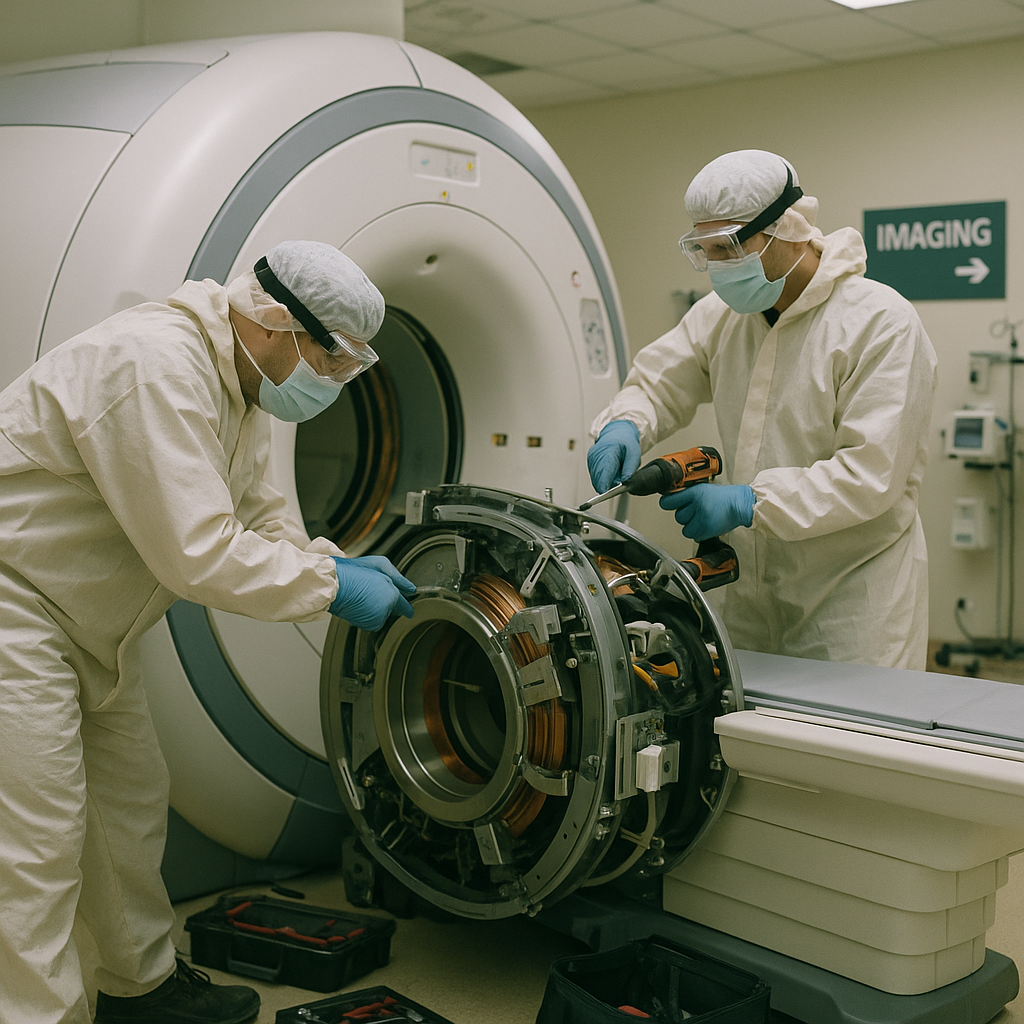
Medical engineers at work dismantling an MRI machine in a hospital imaging facility.
A helium compressor is a specialized device designed to capture and compress helium gas to high pressures for efficient storage and reuse. These machines work by taking helium in its gaseous state and reducing its volume through mechanical compression. This process transforms low-pressure helium into a dense, highly compressed form that can be stored in gas bottles or prepared for re-liquefaction.
In MRI recycling systems, helium compressors are central to reclamation operations. MRI machines use superconducting magnets that require cooling to very low temperatures to maintain their superconducting state. During normal operation, some liquid helium naturally boils off and would otherwise escape into the atmosphere. The compressor intercepts this escaping gas before it can be lost.
The compression process involves capturing the helium vapor that boils off during MRI operation and mechanically reducing its volume. As the compressor operates, it generates substantial heat, which must be properly dissipated to maintain efficiency and prevent system component damage.
Storage efficiency is a critical benefit of helium compression in recycling applications. Compressed helium occupies significantly less space than its gaseous counterpart at atmospheric pressure, allowing facilities to store larger quantities of recovered helium in smaller containers. The compressed gas can later be expanded back to operational pressures or re-liquefied as needed for the cooling system.
Reclamation systems using helium compressors prevent valuable helium from permanently escaping into the atmosphere. Since helium is a finite, non-renewable resource, every liter recovered through compression extends the useful life of existing helium supplies. The compressor densifies the recovered gas to pressures typically reaching 200 bar or higher, preparing it for efficient storage and eventual reuse in cryogenic applications.
How Are Facilities Implementing Helium Recycling Systems?
Healthcare facilities around the world are deploying advanced helium recovery systems to capture and reuse this valuable gas instead of releasing it into the atmosphere. These systems mark a significant departure from traditional practices where helium was simply vented during equipment maintenance and decommissioning. Modern recycling methods focus on capturing helium at various stages, from equipment servicing to daily operations.
The implementation varies based on facility type and scale. Research institutions typically handle smaller volumes but require a consistent supply for ongoing experiments. Hospital systems concentrate on MRI maintenance cycles and equipment replacement programs. Manufacturing facilities that refurbish medical equipment have developed comprehensive recovery systems due to their frequent handling of decommissioned units.
Container-based Recovery Systems
Industrial-scale approaches for helium retrieval have been developed at equipment refurbishing facilities. Specialized container systems designed specifically for helium recovery from decommissioned MRI systems feature helium bubble collection chambers that connect directly to incoming equipment undergoing refurbishment.
The recovery process begins when technicians connect an old MRI system to the container’s helium bubble. A high-capacity compressor then captures and densifies the collected helium to pressures reaching 200 bar. This compression transforms the low-pressure gas into a highly concentrated form suitable for commercial distribution. The compressed helium fills standard gas bottles that vendors purchase for resale to welders, divers, and other industrial users.
These systems efficiently handle substantial volumes. MRI machines typically arrive at refurbishing facilities retaining 25 to 30 percent of their original helium load. Large-scale operations can process 50 to 80 magnets annually, with some facilities recovering nearly 20,000 liters of helium in a single quarter. Container-compressor facilities represent complete industrial solutions that transform waste helium into marketable commodities.
Laboratory-scale Purification Systems
Research institutions have developed approaches focused on continuous recovery during normal operations. These systems address daily helium loss occurring during the routine use of NMR spectrometers and other research equipment. Large university imaging facilities can consume approximately 10,000 liters of liquid helium annually.
Laboratory-scale systems capture warmed helium gas as it exits NMR machines during operation. Copper pipes channel this gas into large storage bags, each roughly the size of an SUV. These collection bags serve as temporary holding chambers while the gas awaits processing. The system must address contamination as helium picks up traces of water and nitrogen from ambient air during the collection process.
Purification occurs through a freezing process that removes water vapor and nitrogen contaminants. The cleaned gaseous helium then flows to a specialized condenser that operates at extremely low temperatures. This condenser transforms the purified gas back into liquid helium suitable for reuse in superconducting magnets. This closed-loop cycle allows the same helium to circulate repeatedly through the facility’s equipment.
The financial benefits are substantial. Research institutions report annual savings exceeding $100,000 in helium expenditures from recycling system investments. Some facilities have recovered thousands of liters of helium since implementing recycling programs. This approach reduces both costs and dependence on external helium suppliers.
Both container-based systems and laboratory-scale purification systems demonstrate that helium recycling requires specialized infrastructure tailored to specific operational needs. Container-based systems excel for high-volume processing during equipment lifecycle management, while laboratory-scale purification systems optimize continuous recovery during daily operations. These implementations provide practical models for other facilities developing their helium conservation strategies.
What Are the Primary Benefits of an Effective Helium Recycling Program?
Resource Conservation and Sustainability
Helium recycling programs address the crucial issue of the finite helium supply. Unlike other industrial gases, helium cannot be artificially manufactured and is a non-renewable resource on Earth. Once helium escapes into the atmosphere, it rises through the stratosphere and is lost to space permanently.
Modern recycling systems can recover up to 90% of used helium, significantly extending the resource’s useful life. Major research organizations report that nearly 70% of the helium used across their facilities comes from recycled sources. This conservation effort reduces the strain on natural gas fields, where helium accumulates over millions of years through radioactive decay processes.
Healthcare facilities and research institutions implementing recovery systems directly contribute to environmental stewardship. By capturing and reprocessing helium that would otherwise be vented, these programs support long-term sustainability while maintaining critical operations.
Significant Cost Reduction
The financial benefits of helium recycling programs provide substantial returns on investment. Research institutions report annual savings exceeding $100,000 in helium costs after installing recycling systems with approximate costs of $500,000.
The cost difference between recycled and purchased helium presents compelling economics. Advanced research facilities have recycled hundreds of thousands of liters of helium at costs below €4 per liter, compared to over €35 per liter for replacement helium. This represents a cost reduction of over 90% for recovered helium.
Universities implementing recovery systems have reduced annual helium purchases from 4,000 liters to just 100 liters. These institutions show that helium recycling programs typically achieve payback periods of less than five years.
Supply Chain Stability and Independence
| Supply Chain Risks | Recycling Benefits |
|---|---|
| Geopolitical disruptions affecting major producers (Qatar, Algeria, Russia) | Closed-loop operations eliminate dependence on external suppliers |
| Market shortages (2006-2007, 2019, recent geopolitical tensions) | Up to 90% recovery rate ensures consistent supply |
| Price volatility and unpredictable costs | 90%+ cost reduction compared to purchased helium |
| Equipment shutdowns costing $250,000+ to restart | Operational continuity regardless of market conditions |
| Research/medical facilities deprioritized during shortages | Internal supply guarantees uninterrupted operations |
Helium recycling programs offer essential protection against volatile global supply chains. The helium market is subject to frequent disruptions due to geopolitical factors, with major shortages occurring in 2006-2007, 2019, and during recent geopolitical tensions affecting Russian and Qatari production facilities.
Organizations relying on external helium supplies face significant risks during these shortages. Research institutions and medical facilities are often deprioritized when supplies become scarce, as large industrial users typically secure available inventory first. During the 2019 helium shortage, some facilities faced equipment shutdowns costing $250,000 to restart and months of downtime.
Recovery systems eliminate this vulnerability by creating closed-loop operations. Facilities with effective recycling programs can maintain operational continuity, regardless of external supply fluctuations. This stability is particularly crucial for medical imaging centers, where MRI machines require continuous helium cooling to function.
Enhanced Operational Efficiency
Helium recycling programs streamline facility operations by reducing logistical complexity and improving resource predictability. Organizations no longer need to coordinate frequent deliveries, manage bulk storage requirements, or plan research schedules around helium availability.
The operational benefits extend beyond convenience. Facilities report improved workflow efficiency when helium supply is predictable and managed internally. Research teams can schedule experiments without concern for helium market conditions, and medical facilities can maintain consistent imaging capabilities.
Modern recycling systems integrate seamlessly with existing equipment through automated collection networks. These systems operate in the background, continuously capturing boil-off helium and processing it for reuse without significant staff intervention or operational changes.
What Does the Future Hold for Helium Consumption in MRI Technology?
The medical imaging industry is at a transformative point. Traditional MRI systems use between 1,500 and 1,600 liters of liquid helium over their operational lifetime. These systems require regular helium refills due to natural boil-off, leading to ongoing supply chain dependencies and operational costs.
Innovative magnet technologies are changing this situation significantly. Advanced sealed magnet systems operate with less than 1 liter of helium in completely sealed designs. This amounts to a 99.95% reduction in helium use compared to conventional systems.
The sealed-for-life design prevents helium loss during normal operation and servicing. Healthcare facilities no longer incur the costs and logistical challenges of regular helium refills. Emergency quench events, which traditionally result in complete helium loss, become manageable incidents rather than major operational disruptions.
These advanced systems offer additional operational benefits beyond reduced helium use. The compact design removes the need for quench pipes, lowering installation costs and increasing siting flexibility. Facilities can install MRI systems in locations that were previously unsuitable due to infrastructure constraints.
Modern low-helium platforms show that reducing helium consumption does not compromise diagnostic capabilities. These systems maintain full clinical functionality while minimizing environmental impact. The technology supports advanced imaging protocols and provides image quality comparable to traditional high-helium systems.
Manufacturing innovations extend beyond individual system improvements. There is industry-wide momentum toward sustainable design principles that prioritize resource conservation throughout equipment lifecycles. This includes modular upgrade capabilities that extend system lifespans without requiring full replacements.
The economic implications encourage widespread adoption. Healthcare facilities report significant cost savings from eliminated helium expenses, reduced downtime, and simplified maintenance requirements. These financial benefits make low-helium technologies appealing investments for sustainability-focused organizations.
Supply chain resilience is becoming increasingly important as global helium availability fluctuates. Medical facilities adopting sealed magnet systems protect themselves from future supply disruptions and price volatility. This strategic positioning ensures continuity of diagnostic services, regardless of external market conditions.
Conclusion: A Two-pronged Approach to Helium Sustainability
Addressing helium scarcity in medical imaging requires both immediate actions and long-term strategies. Helium recycling systems, equipped with advanced compressor and reclamation technology, offer crucial short-term relief by capturing and reprocessing helium that would otherwise be lost to the atmosphere. Healthcare facilities have reported significant cost savings and stable supplies with proper recycling infrastructure. Traditional MRI systems, which typically lose 3-4% of their helium monthly, can greatly reduce wastage with systematic recovery programs.
Looking ahead, low-helium and sealed magnet technologies will fundamentally lower demand. Advanced systems use only 7 liters of helium compared to over 1,500 liters in conventional scanners, eliminating the need for ongoing helium refills while maintaining diagnostic quality. By recycling existing systems and adopting sustainable MRI technologies, we can ensure ongoing access to critical diagnostic tools. For comprehensive recycling system implementation, contact Okon Recycling at 214-717-4083.
Send Us a Message
Questions about what we do? Interested in commercial services? Let us know below and a member of our team will get back to you.